


Showing posts with label dollhouse. Show all posts

Saturday, December 5, 2020

An old sewing machine table

This is the project that started all that repainting, the sewing machine table. I got it when my parents' house was put to sale, and it stood in my living room corner for a year before I got the motivation to do something to it. That was probably a good thing as it had been in a cold storage for some time, so giving it time to dry properly in room temperature couldn't hurt. The photo below shows the table as it was when I got it. Of course I cleaned it right away before letting it stand in my living room for a long time.


The sewing machine wasn't in working condition, so when I started the work on this project, the first thing to do was to remove it and the motor that was under the table. Seriously, that motor would probably have been a fire hazard, if I had been stupid enough to try to connect it.


Here is the table with all the unnecessary parts removed. The veneer in the front edge had suffered from moisture, so that was the first issue to be addressed.


First I sanded the front edge a bit and removed the parts of veneer that were totally loose, and then I got some filler to make the surface as even as I could.


Here is the result after filler and sanding. Not perfect, but I had to choose between leaving it a little bumpy and taking the risk of making a total mess. A little bumpy was the safer option, especially considering the purpose for which this table would be used.


The next stage had to be done in the balcony as there would be rust flying around. All the metal parts needed thorough brushing before painting. I used a wire brush to remove all the rust that I could remove. There was no need to get it all off, because the instructions in the paint can said the paint could be used even on top of rust. However, I wanted to remove everything that was coming loose easily.


This is the metal paint I used. I knew absolutely nothing about metal paints, but reading carefully the instructions in the can, I thought it sounded right. I didn't want any particular finish, just black color that would stick to the metal.


Here's a little time lapse clip of painting the metal parts.


The result looked nice enough. I applied two coats of paint, because the first one didn't cover everything evenly.


The foot pedal needed to be secured in place, so its front and back would stay off the floor. The original chain was badly rusted, so I bought a new chain and hooks to attach it to the loop in the upper right of the foot pedal. The chain was already black, but the hook needed to be painted.


Here is the table top before painting. It may seem strange to have a table with a hole in the middle, but this was actually perfect for the intended purpose as the space below the table level would hold cables nicely.


Here is the table all painted. You can see the chain here, attached to the foot pedal and going over the lower horizontal bar above it.


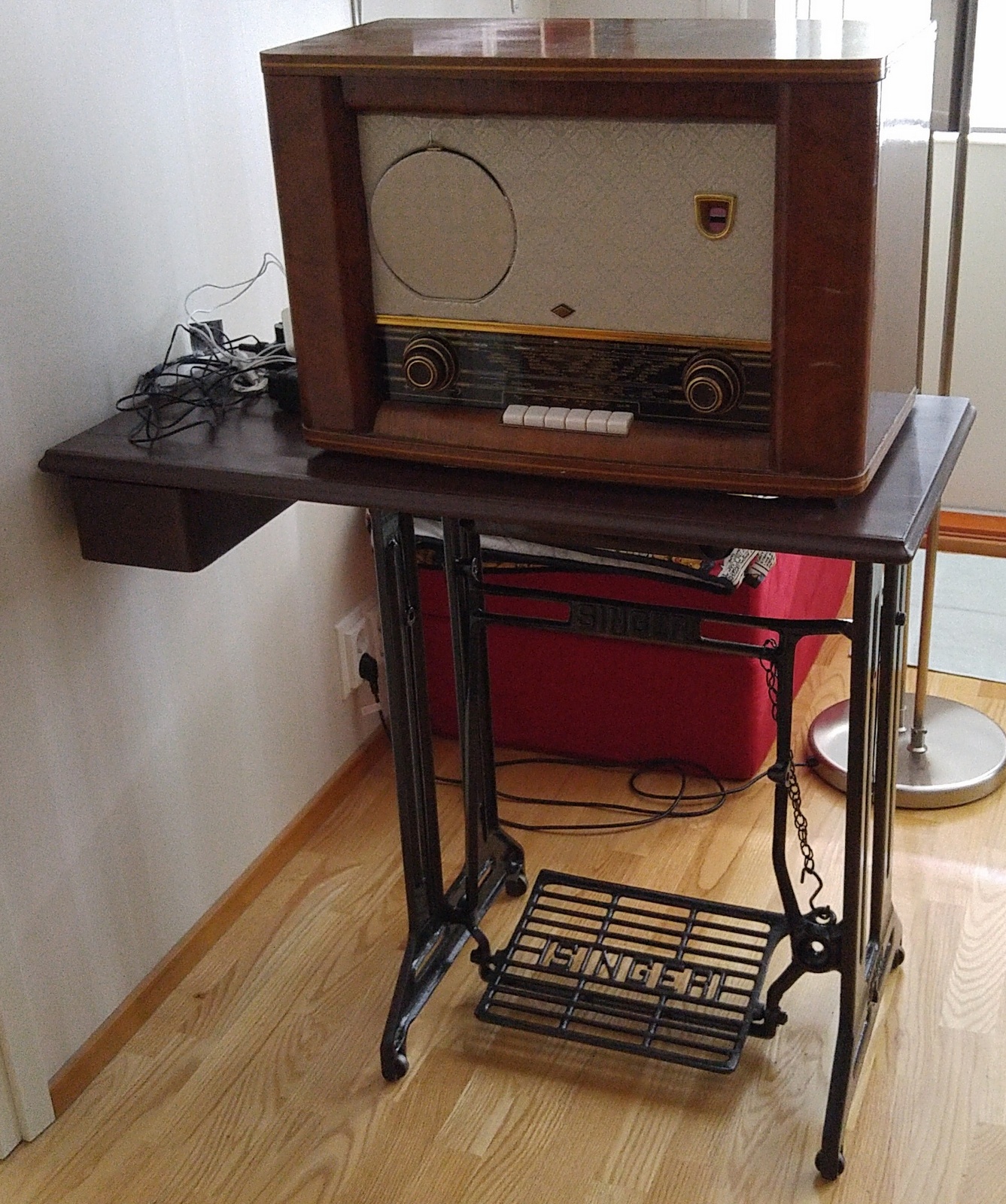
The planned use for the table was this. What looks like a radio is actually a dollhouse, and the old sewing machine table made a fitting stand for it. The project wasn't quite finished at this stage, but I'll write another post about the smaller stuff that needed to be done in addition to painting the table.


Friday, October 17, 2014

Bastet

I haven't been making any miniatures lately, but I did rewire Bastet as the old lights under the floor stopped working. Here are two videos, first about the rewiring and the second about furnishing the bar.


Wednesday, October 13, 2010

Classroom desks and chairs

I realized I hadn't added these here. I needed a classroom setup for my photo story, so I had to make some desks and chairs. The table tops are made of pieces of cork left over from other projects and the vertical parts are made of wooden cigarette holders.

Here are the unfinished desks and chairs:


The wooden cigarette holders belonged to my uncle and my father saved them for me when cleaning the house after my uncle passed away.


Here are the finished pieces in the classroom set, which is just a temporary one, set up inside a painted plastic container.


Monday, August 24, 2009

Dollhouse for a dollhouse with working lights

I used a dollhouse wardrobe to make a large dollhouse for a 1/12 scale dollhouse. I added shelves to create the separate floors and added one wall upstairs to divide it into a bedroom and bathroom. Then I made holes in the back wall for installing lights, which are a string of Christmas lights in 1/12 scale.


The next picture shows how the lights were installed. As I only needed 10 lights inside the house, I attached the extra two lights under the house to provide additional lighting for the room in which this dollhouse will be placed. Of course, I could have made two holes for the living room, for example, and installed 4 lights there.


Then I furnished the house. I used pieces of pictures found in magazines for wallpaper and other decorations. The furniture is made of cast metal. Some pieces were ready painted when I bought them, some I have painted myself.


Sunday, July 12, 2009

Dollhouse kitchen

I found a method for keeping the fridge doors closed. A hobby shop had this thin magnetic sheet you can cut to desired shape and size.

Here is the fridge painted and magnets in place. When you cut the magnets, you need to cut one side first, then place it against the sheet to find a place for cutting the opposite part.

The last piece missing from the kitchen was the oven. I made it using balsa wood. The basic structure is very simple.

The glass on the oven door is a piece of overhead transparency.

The hinge is made of thin cardboard. That is the easiest way of making a hinge and it is durable enough after it has been painted as the oven door is very light. I used the same method for the fridge. I used magnets for keeping the oven door closed.

The cooking plates are pieces of black rubber and the grey buttons are from buttons of an old remote control.

I know there are different types of ovens, but I'm used to having an electric one, so that was the easiest for me to make.

Here is a picture of the entire kitchen.


Sunday, July 5, 2009

Dollhouse fridge

None of the dollhouse fridges I have was suitable for the dollhouse I'm building, so I decided to make one specifically designed for this house. It's a good idea as I have made the kitchen cupboards myself and plan on making the oven as well.

The kitchen looks like this:


I used a variety of materials for the fridge as there was not enough left of any one material. So, there's cardboard, foam core, balsa wood and a piece of some harder wood. The structure is basically that of a regular cupboard, except the shelves aren't as deep as they could be. This is because there must be room for the shelves inside the door.


This is the inside of the door. The (approximately) 45 degree angle on one side is there to make sure the door can be closed. Another option would be to make the shelves a lot shorter.

The fridge isn't finished yet. Next, it needs to be painted and some sort of handles attached. I also need to figure out how to keep the doors closed. I'm thinking of using small magnets, if I can find ones small enough.


Tuesday, April 28, 2009

Fantasy Villa in 1/24 scale

I added some customized dolls to my web site. They are Lanard's Petite Catwalk Kitties and one of them got transformed from yellow to a black cat while others are less customized.

The actual subject of this post is a 1/24 scale dollhouse I have finally finished. My website has the pictures from halfway through, but nothing from the beginning of the project as I did not have a digital camera at the time. I finally decided to scan the photos I took on those early days. The picture quality is not very good, although the photos were perfectly fine. I guess it is the scanner, but that would not be a suprise as it is about ten years old. Still, it is working and even poor quality is better than no photos at all.

I ordered the house from the UK and it arrived flat packed in a fairly large package. A word of warning, if you hate puzzles and Ikea furniture, this house is not for you. The pieces are laser cut in wood boards and the house is basically a 3D puzzle. I love puzzles, so this was just the thing for me.


After you have taken the boards out of the package, the very first thing to do is to use the pictures on the back of the box to identify and mark all parts. The parts are numbered in the pictures and you should number them in the wood boards in the same way with a pencil. This is essential as you will inevitably end up with a piece you cannot figure out and the numbers will help you find the piece where it is supposed to be attached. The numbering in the pictures was accurate and numbering the pieces myself saved me from a lot of trouble.


The next step is to separate the pieces from the boards. You should sort the pieces into separate piles according to the part of the house they belong to.


After that, I assembled small parts of the house without using any glue. This was just to check that I had understood correctly what goes where and also to keep the relevant pieces together. You should only use glue when you have checked that the assembled part will fit in its place (if it will not, it needs to be modified).


The next pictures show the house with just the walls and part of the staircase in place. The first picture is the view from the back and the other one shows the front.


Even though this is a laser cut kit and everything should be accurate, that is not the case. If you assemble the house without any modification, it will be nice, but there will be gaps here and there. It will be much better with some extra effort. For example, I decided to electrify my house and you can see the copper tape in the picture below. I had only done this once before for a 1/12 scale house, so it was a bit challenging, but quite manageable. Another thing is that the house is assembled using a slot and tab system. I decided to cut off quite a lot of those tabs and fill the holes designed for them where necessary. This makes assembly a bit harder because you need to glue a lot, but the end result is much nicer. I also filled any gaps between parts that would have been visible in the finished house.


There is one flaw in the design of the house and that is the missing piece of floor under the staircase going to the attic. I added that myself as you can see in the next picture. It was quite easy as I could cut the piece from the wood boards left over after removing the pieces.


Then it was just painting and wallpapering and those pictures can be found on my web site,

The finished house looks like this.


Building this house was fun and I'm sure kids would love the house even if assembled as it is intended. I just wanted something even nicer and also, I did not want to get it done too quickly as the building is the best part for me.

About those leftover pieces I mentioned, you should definitely save them as they have all sorts of interesting shapes and can be used for making your own furniture for the house. There is also a FURNITURE SET that will fit this house. I have got that one and the furniture size is also suitable for 1/16 scale houses such as Lundby. Another thing you should save is the box as it is invaluable as a reference, especially if your project takes as long as mine (the house was sitting on the shelf for months at times when I did not have time for it).

The name of the house is FANTASY VILLA SET and it is available in Amazon at the moment. I noticed that they also have the GOTHIC HOUSE SET, which was the other house I was considering when I got this one.