Showing posts with label repaint. Show all posts

Tuesday, December 8, 2020

Chairs repainted

I thought I had gone through all of the repaints, but there were still some photos of chairs I painted at the same time as all the other stuff. It's amazing how much I could get painted with three small cans of paint.

First, there is this kitchen stool that's at least 20 years old, maybe older, but didn't really look like it. The only thing showing age was the slightly worn varnish on the steps and the top level. However, I wanted to take the opportunity to paint it as I was painting other furniture.


Then there were these two chairs. Not quite as old as the kitchen stool, but more worn. There's so much light colored wood in my home that some variety doesn't hurt, so these ended on the list of items to be painted.


Here is the painted kitchen stool. I used the same paint as for the sewing machine table. You couldn't really guess the age of this now, as good as new.


For the other two chairs, I used a colored varnish, which required way too many coats to look nice, but finally it got to the point where I was satisfied with the result. Here they are drying after the final coat of varnish. 


Then there was also this small table. The table top was in a fairly bad condition, so it needed painting, this wasn't just because I fancied a change. I didn't bother to paint the legs, because it would have been a bit complicated as this is a folding table. It was complicated enough to varnish the folding chair in the picture above.


Monday, December 7, 2020

How to keep acrylic paints usable

I was looking for suitable color for one of my current projects when I realized I hadn't checked the acrylic paints for a couple of years. They are easy to keep usable, if only you remember to check them regularly.


The first thing to do is to get a bottle open. Usually it's enough to open the lid (the upper part of the top that covers the small hole on the top) to let some air in, if you can't get the top to turn. Once some air gets in, the top should turn more easily. If not, you can try using a kitchen towel to get a good grip. This time I had a couple of bottles really badly stuck, and I found out that the sort of cleaning pad shown in the next picture is quite useful. The rough side gives much better grip than a towel.


Once the bottle is open, take a long, thin stick. I use a screwdriver, because metal is easy and quick to clean before using it for the next color. Stir the paint to get an idea of how thick it is. If it looks normal, just stir well, close the bottle again and shake it a few times. If it's thick, add some water, close the bottle and shake vigorously to mix the paint and water. The amount of water depends on how much paint there is and how thick it is. You can add the water a little bit at first, shake, then check, and add more if needed.


If the grooves inside the top have a lot of dried paint in them, clean the inside before closing the bottle again. A screwdriver is good for this purpose as it is easy to scrape the paint away with it and its tip fits the small grooves.

If you've got bottles with so little paint left that it's not worth the trouble, you can clean the bottle and use it for mixing your own shades. In the first picture of this post, the second bottle from right is that kind. I remove the label to distinguish these bottles from original colors, and usually also write the purpose of the mixed color in the bottle, so I'll remember later why I mixed it.

To clean a bottle, put it and the top into warm water and let soak for a few hours. Then you should be able to remove the label easily. Rinse the bottle thoroughly, and if there is paint still left, fill it about half full, close it and shake well. This should remove at least some of the remaining paint. Repeat as many times as necessary. If paint is still stuck, let the bottle soak in warm water longer, overnight if necessary.


Removing the label tends to leave the bottle's sides a bit sticky, but that's just a nuisance, so I haven't tried to do anything about it. Solvent would remove the remaining glue, but I'm not sure what it would do to the plastic, so I just leave the bottles as they are.

Sunday, December 6, 2020

Additional parts for the table

The sewing machine table had a small wooden drawer under the table top. It was falling into pieces as all the corners were loose and only the bottom was keeping it together.


The first thing to do was gluing the corners with PVA glue. I left the original nails in place, tapping them in with a small hammer. I didn't think they would be much use otherwise, but they would help the pieces to keep their original alignment while the glue was drying.


The rails for the drawer under the table were also a bit broken. I could have made new ones, but I decided to try fixing these first and only make new ones if I had to.


The composite picture below shows the different stages of fixing the rails: filler applied (pictures 1 and 2), shaping the rails by sanding (pictures 3 and 4), and finally the result (picture 5), which isn't perfect, but works.


After everything was ready, the parts needed painting. It never stops amazing me what you can do with filler and then paint the result, and nobody can guess what's underneath.


Another issue was hiding cables. The dollhouse and table look so nice that it would be a shame to ruin the impression by having a bunch of cables lying around. The answer to that problem was using some leftover pieces to build a cover under which all the cables that don't fit in the space under the table can be hidden. The cover is made of pieces of wood and particle board glued together using PVA glue.


I painted the cover black, using what remained of the metal paint. It's not meant for painting wood, but it was available and I didn't want to throw away what was left. I always prefer using leftovers for other projects. When the paint was dry, I attached some stickers for decoration. Those were the only pieces I bought specifically for making the cover, everything else was leftover materials. In the photo below, you can see the cover as it looks seen from the front.


Here's view from the back. The back is open to allow access to the extension cord's power switch. The cover is taller than is needed for accommodating the cord and cables, but that is for ventilation. In a smaller space, the cables could get hot. Even with the extra space, I wouldn't recommend leaving the power on for an extended period and certainly not unsupervised. This works for the purpose it's used here, because the dollhouse lights are never on when I'm not at home.


Saturday, December 5, 2020

An old sewing machine table

This is the project that started all that repainting, the sewing machine table. I got it when my parents' house was put to sale, and it stood in my living room corner for a year before I got the motivation to do something to it. That was probably a good thing as it had been in a cold storage for some time, so giving it time to dry properly in room temperature couldn't hurt. The photo below shows the table as it was when I got it. Of course I cleaned it right away before letting it stand in my living room for a long time.


The sewing machine wasn't in working condition, so when I started the work on this project, the first thing to do was to remove it and the motor that was under the table. Seriously, that motor would probably have been a fire hazard, if I had been stupid enough to try to connect it.


Here is the table with all the unnecessary parts removed. The veneer in the front edge had suffered from moisture, so that was the first issue to be addressed.


First I sanded the front edge a bit and removed the parts of veneer that were totally loose, and then I got some filler to make the surface as even as I could.


Here is the result after filler and sanding. Not perfect, but I had to choose between leaving it a little bumpy and taking the risk of making a total mess. A little bumpy was the safer option, especially considering the purpose for which this table would be used.


The next stage had to be done in the balcony as there would be rust flying around. All the metal parts needed thorough brushing before painting. I used a wire brush to remove all the rust that I could remove. There was no need to get it all off, because the instructions in the paint can said the paint could be used even on top of rust. However, I wanted to remove everything that was coming loose easily.


This is the metal paint I used. I knew absolutely nothing about metal paints, but reading carefully the instructions in the can, I thought it sounded right. I didn't want any particular finish, just black color that would stick to the metal.


Here's a little time lapse clip of painting the metal parts.


The result looked nice enough. I applied two coats of paint, because the first one didn't cover everything evenly.


The foot pedal needed to be secured in place, so its front and back would stay off the floor. The original chain was badly rusted, so I bought a new chain and hooks to attach it to the loop in the upper right of the foot pedal. The chain was already black, but the hook needed to be painted.


Here is the table top before painting. It may seem strange to have a table with a hole in the middle, but this was actually perfect for the intended purpose as the space below the table level would hold cables nicely.


Here is the table all painted. You can see the chain here, attached to the foot pedal and going over the lower horizontal bar above it.


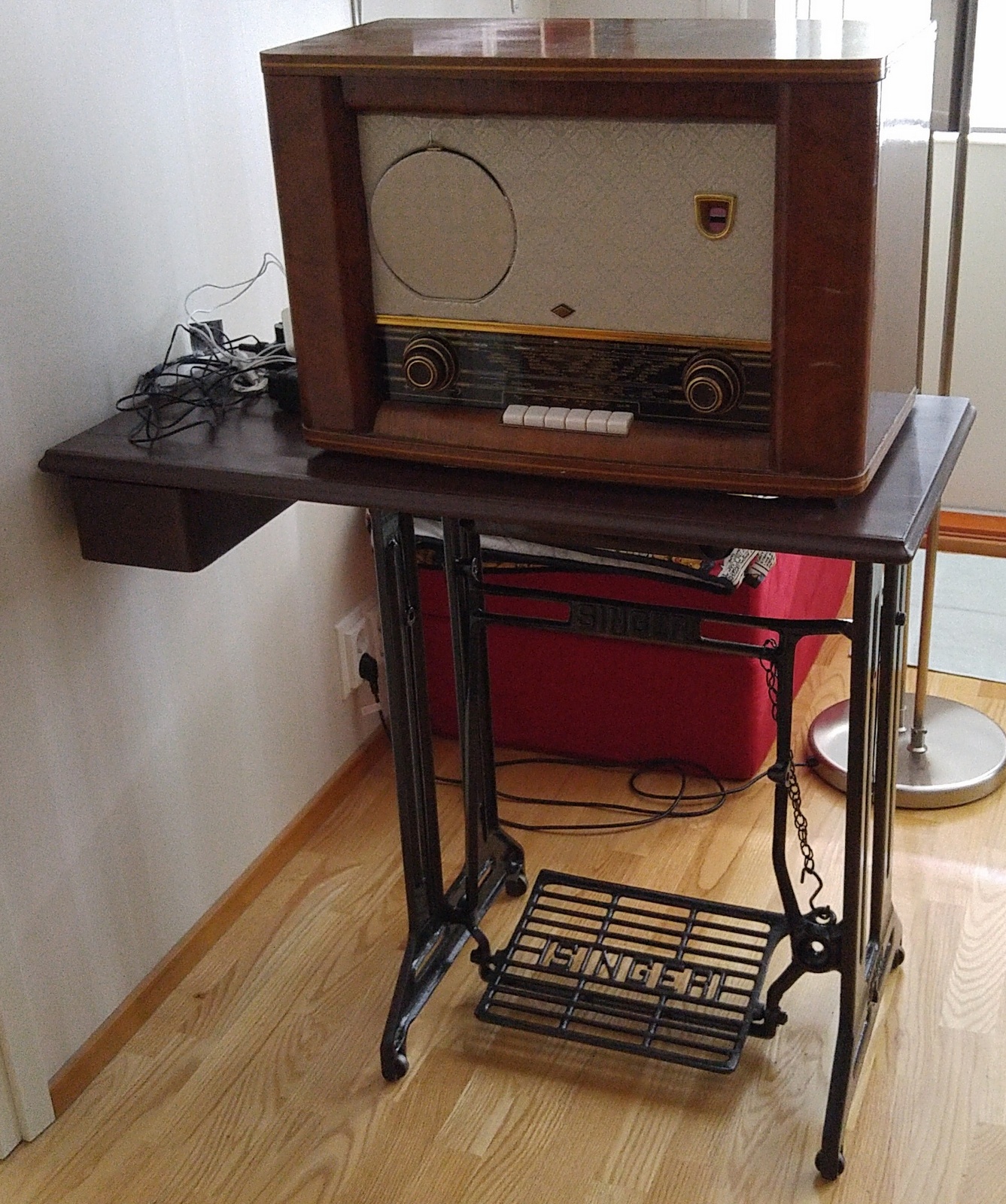
The planned use for the table was this. What looks like a radio is actually a dollhouse, and the old sewing machine table made a fitting stand for it. The project wasn't quite finished at this stage, but I'll write another post about the smaller stuff that needed to be done in addition to painting the table.




Friday, December 4, 2020

Repainting a small drawer

Here's another piece I repainted. I bought this new and used it as it is for some time, but decided to give it some color when I was painting all the other stuff.


I painted the insides of the drawers white, the visible outside parts red, and the rest of the outside parts white. I wondered if I was going too far with painting sides that wouldn't be visible, but apparently it's a good idea to paint all sides to prevent any warping.


I didn't paint the inside parts of the frame, because I didn't want brown streaks on the white parts, and that would have happened at some point.


After painting, I applied some stickers to the front of the drawers.


And here is the final result. The combination of red and brown works quite nicely, although it was brought on by the fact that those were the colors I had available. Of course this, the box on the back and the other small drawer under this one also fit together nicely when the color scheme is the same.


Thursday, December 3, 2020

Another repaint

This was originally a drawer on wheels, the sort you have under a desk. Made of white melamine covered board and practical, but boring. Since then, it has served in various other purposes, such as housing a PC.


I went through some old photos and managed to find a picture in which you can see this as it was originally, under the desk beside the armchair. The picture was taken 25 years ago as me and my then boyfriend moved to a new place. The rest of the desk is long gone now.


At some point, I was experimenting with glue varnish and decided that the white melamine could do with some livening up. I went through all the comics I had, and as I had purchased all of the Sandman comics as trade paperbacks and only had some in a magazine format, I decided to sacrifice those magazines. It's my favorite comic, and I picked some of my favorite parts from those magazines for covering the outside, leaving the inside white at that point.

That's how it stayed for years, until I had some other painting to do and decided that the inside could do with some livening up as well. I got red paint for this, because red is bold and goes really well with the outside design.

There was only one drawer left at this point, and I decided to make some shelves instead. I used leftover pieces from a DVD shelf I had taken apart for making a dollhouse. The easiest way to attach two pieces of board together is using the kind of metal pieces you can see in the picture below. They will remain under the shelf, not visible, so it doesn't matter that they don't look nice.


After attaching the pieces together securely, there was a gap in the middle. Some filler and sanding fixed that problem. If you get the surface even enough, you can't even tell it's two pieces once the shelf has been painted. And who's looking at the surface anyway when the shelves are full of stuff?


The lowest shelf in the next picture looks flimsy. That's because it used to be a drawer and have a front, but didn't anymore. (The holes in the back wall are from the time the PC was inside this. All the cables went through there.)


I realized the lowest shelf wouldn't hold anything heavy, so I removed the remaining sides and used them to create supports underneath to make a proper shelf. I just glued the supports in place using PVA glue, because any stress to the shelf would come directly from above, so nothing would be pulling the shelf and supports apart.


When I had all the shelves I needed, I painted the inside all red. It took a few coats as paint doesn't stick to melamine very well, even after cleaning all the surfaces with turpentine. In that respect, covering the outside using varnish glue was a good idea. The only problem it has caused in all these years is that something once stuck to the top and tore a little piece of paper off. I covered the top with clear adhesive plastic to prevent that from happening again.


Wednesday, December 2, 2020

The box my dad made

My dad was a carpenter. In his day job, he made parts for glass fiber boats, but he also made various furniture for other people. These people included, for example, his employer's family members and a man who was Finland's prime minister in 1970's and 1980's (his summer cottage was near us and that's where dad did some work for him).

In Finland, we have this saying, "the shoemaker's kids have no shoes." In this case, the carpenter's family had very few items made by him, because he was always making stuff for others against a payment. However, there were some, including the box below. It was my mom's, but I got it when the house had to be emptied for sale. The box was varnished (not very carefully, the surface was a bit rough), but as I was painting some pieces of furniture, I decided to paint it as well, because there was plenty of paint.


I had white, red and brown paint, because those were needed for the other projects. I painted the inside white, because the larger compartment has a divider (seen in the picture above) that divides it into six small, deep compartments, and a light color makes it easier to see inside. I chose red for the outside as it's more cheerful that dark brown.


Here's the lid in place after the paint had dried. The box isn't really anything special in any other way, except that it was one of the things my dad made for my mom.


Here's an outside view. The box is on top of one of the other painting projects, actually the one for which I originally needed the red paint. I'll post about that later.


Wednesday, November 25, 2020

Repainting a relief

 As I was cleaning my parents' house for sale a few years back, my aunt gave me this relief as she was going through her own belongings that were there. She said the lips were painted later and this was originally all black.


I decided to repaint this all black. The first step was to clean it. As I was going to paint it, I used acetone, so I could remove as much of the paint from the lips as possible. Acetone is harsh, but it also cleans the surface efficiently before painting.

Then I used matte acrylic paint and applied several coats of it. The result looked quite nice, but I knew it wouldn't stay that way, so I used sealer to make the surface easier to clean. The picture below shows the surface after painting, before the sealer.


I put the original choker back, but made new earrings, which I secured in place using hot glue.


Wednesday, November 9, 2011

Greyscale Ghoulia

I wasn't quite sure what to expect as I started removing the head from a Monster High Ghoulia doll. I did it with that small screwdriver you can see in the photo. The construction turned out to be similar to Barbie's. The only reason for that odd round knob seems to be that Monster High dolls have such a thin neck that the post could not be attached to it without making that part thicker.

Next, it was time for the hair to go. I cut the hair as short as possible and then used the wide tweezers to scrape the inside of the scalp to pull the hair in. When everything was inside the head, I used the other tweezers to pull it all out (those tweezers are easier to use as you press to open them, so their "default position" is closed).

After removing all original paint using acetone, it was time to apply some new. I used Folk Art's acrylic paints and mixed the different shades myself.


I had thought that I would do a reroot, but I came across the perfect yarn for her hair and it was too thick for rerooting (or at least I couldn't figure out how it could be done). So, I used a sewing machine to sew the strands together for easy gluing. It's fairly easy when you arrange the strands on top of baking paper and sew at least twice across them. When finished, you just need to rip off the paper (by this time, it will have so many holes in it that it will be easy to remove).

I used three strips: back, front, top. The top one is sewn from the middle to make a parting. I used PVA glue to glue the hair in place as it has worked with a smaller doll I customized earlier. If it won't hold, I'll use super glue to glue it back. Even if I have to resort to that, the first gluing won't be a waste of time as I expect super glue to work better when there will be a smooth surface (the PVA glue strip in the hair) against a smooth surface (the vinyl).

And here Ghoulia impersonates Cousin Itt as she waits for the glue to dry.

Finally, photos of the finished doll. She's wearing a business suit for now as I haven't yet made her outfit. The boots are the ones I made for Draculaura a while ago.