Showing posts with label bag. Show all posts

Sunday, March 13, 2022

Various projects

I have posted several videos after the last one I added here. Some of them are about taking apart leather jackets I bought from a charity shop closeout sale for very cheap. You can find them on my YouTube channel, so I'm not adding them all here, but here is the first thing I made using those jackets.


I also made something else out of leather, but this wasn't recycled leather, just some very old (some of them 20 years old) pieces.

Wednesday, January 19, 2022

Making a backpack

This video is in two parts as it took quite a long time to explain everything. Making a backpack is not that difficult, but it is time consuming and involves many steps.


Tuesday, June 1, 2021

Shoulder bag

The spring semester is over now. The course that lasted from mid-April to the end of May got graded last week. The course was about making a product or series of products using recycled materials. I chose jeans fabric the school had in large quantities. It counts as recycled material, because it's factory leftovers that would be wasted otherwise.

I didn't do everything in the proper order, but I will present things in order here. So, the first thing is the presentation picture of the product. I actually drew this last, when all the bags were finished.


I made a series of 5 bags, which meant I had to cut parts for the entire series first. The picture below shows parts of the lining drawn with chalk on the reverse side of the fabric. It is so much easier to avoid wasting material when you're cutting a batch instead of just pieces for 1 bag. 


Here are all the pieces needed for the bags. The fabric with flowers is for the bottom part of the lining. It's the most visible part of the lining, so I thought it would be nice to have something more interesting there.


I made the front pieces by weaving strips of the fabric into a chessboard pattern. First, I sewed the strips to the upper and left edges, and then, after weaving, to the opposite edges.


Here are the finished front pieces. Each was to be cut in half diagonally, so there was one extra for each. That actually messed up my calculations at one point as I was calculating the fabric needed for 5 halves, not realizing I needed to make 3 rectangles for both color combinations.


The way to cut these in half was to first stitch diagonally twice and then cut between the stitched lines. I folded the pattern in half, placed in on top of the piece, and then used the folded edge as a guide for the first stitching. The second was easy to do using the first as the guide.


When I had the two halves, I first sewed the 3 stripes together and then the resulting wider piece in between the halves. As you can see, the front pieces were complicated and they took a lot of time to make. Too much time to make this project in any way financially viable. The two-tone pieces in the picture are for the backs. The original plan was for the back to be black, but as I couldn't get wide enough pieces of the jeans fabric for that, I changed the plan. 


I didn't take pictures from the assembly stages, so here is a finished bag. There were 5 identical bags, but I only took a picture of one as that was part of the assignment (taking a product photo).


The project looks fairly simple described this way, but it was a lot more complicated as it began with a lot of experiments with different techniques. Mostly failed experiments, I might add, but of course even a failed experiment is a good thing, because it tells you that is not the way to proceed.

After the bags were finished, I decided to try an alternative technique. The front pieces took a lot of time to make, so I tried different material and slightly different order of doing things. The experiment below is made of textile band. Its edges did not require stitching, so that reduced the amount of time required quite a bit. I haven't used this for anything yet, but I might make another bag for myself later (the 5 bags I made went on sale at the school).


My grade for the course was 5 (on a scale of 1-5), so I was quite pleased. Good grades are always nice, even when you don't actually need them. What they show me is that I'm doing things right.

 I had time left over after this project, so the teacher gave me a customer project to make. I'll be posting about that later.
Monday, March 1, 2021

The bunny bag

I finished the bag I mentioned in the previous post. It's made of slightly stretchy peach colored fabric with cotton and padding for the lining and the bunny picture on the flap. The picture below shows all the pieces. The structure is mostly the same as in the bag with geometrical patterns I made earlier.


This bag has a lining, and it is made in the same way as in the makeup bag, except the top is open. I first stitched the cotton and padding together close to the edges and then sewed the pieces together, leaving 1 cm seam allowances. The inside pocket was made before stitching the cotton and padding together.


I used velcro for closing as I had no buckles left. The front of the bag has vertical pieces of velcro for adjustment, while the underside of the flap has a long horizontal piece. The order of making the flap is as follows: sew the velcro into the underside piece of the flap, stitch all layers together near the edges, sew bias binding to the side and bottom edges of the flap, and finally sew the flap to the back piece of the bag.


The next step was to sew the front, back and side pieces together to form the outside of the bag. Once that is done, turn the bag right side out and insert the lining.


This is the finished bag. You can either turn the upper edges of the lining outside and stitch the edge or use bias binding for the edge. I had some issues with measurements, and it was easiest to cut the upper edge of the lining along the upper edge of the outside and use bias binding.


The shoulder strap was a bit tricky to sew in place, because of the number of layers of fabric, but my sewing machine was just able to manage it. Any more layers would have been impossible. Like with the first bag, I did not make an adjustable strap, because I haven't been adjusting the strap of the bag I originally used as the model, so that length is just right. Note also that I sewed the strap in place last. Normally it should have been sewn before attaching the lining, but as the outside fabric was stretchy, I wanted to attach the strap also to the non-stretchy lining to help the bag keep its shape.


Here is the outside of the finished bag. There are some errors that are due to the peach fabric being stretchy, but I decided to ignore them. This was basically a prototype, just for testing what the result would be like. And the most important lesson I learned is that using stretchy fabrics for something like this isn't a good idea.


Thursday, February 4, 2021

Use for the swatches

I mentioned in an earlier post the 5 € batches of fabrics I got from Eurokangas. The latter one contained a set of swatches (in the middle below) with 32 different colors of the same fabric. I figured out what to do with them, so yesterday's project at school was that.


First stage was to cut the swatches to 15x15 cm size and overlock the upper and lower edges of each. Next, I arranged them to three strips of 8 pieces. Then I sewed the pieces of each strip together, ironed the seams, stitched on both sides of the seams, and used an overlocker for the vertical edges.


Then I sewed and stitched the vertical seams to get one big piece, and folded it in half and sewed the side seams.


Here's the other side.


I used a couple of the pieces for making an inside pocket. I used black bias binding as the top edge and handles would be made of black fabric.


The top edge wasn't quite finished as I took this photo, but you get the idea. This bag is for grocery shopping. It is tall and relatively narrow, which means it can accommodate a lot of stuff, but it is also easier to pack things in it so that they will stay upright and won't fall over.


Wednesday, February 3, 2021

The shoulder bag

I finished the shoulder bag yesterday. This time I took several in-progress photos. The first one is after cutting the main pieces needed for the bag. I used one of my existing bags as the starting point, and figuring out the needed pieces and the order of assembly took quite a bit of time. The fabric is called Art Deco Punos and it's sold by Kangaskeskus.


The very first thing I did was attaching one half of the buckle to the underside of the flap. That needs to be done first, so the stitches required won't show on top of the flap. Then I put the flap pieces together and sewed the bias binding to the flap edges. After that, I sewed the flap to the back pieces (two pieces, because the flap couldn't be attached to the top edge due to everything else that needed to be attached there).


There were some parts that had to be assembled separately. The first one was the zipper for closing the bag. The edges of this piece were later sewn to the upper edges of the front and back pieces.


Another separate piece was the inside pocket. This was what led the teacher to give us the exercise of sewing pockets. In the exercise, there was a separate pocket behind the zipper, but in this case there's just a small piece of fabric sewn on the right side, then cut open in the middle and turned to the reverse side to form neat edges for sewing the zipper.


Before the separate pieces could be sewn in place, the sides/bottom (one piece) had to be sewn to the back piece and then to the front piece. I stitched these seams, and the picture below shows the stitching of the latter seam in progress. This was probably the hardest part of the assembly, although not the most time-consuming.


The next photo shows the finished bag. After finishing the previous stage, I attached the other half of the buckle to the front piece, the inside pocket and the part with the zipper to the upper edge of the back piece, the other edge of the latter to the upper edge of the front piece, and the ends of the shoulder strap to the sides. The final stage was sewing bias binding to the upper edge.


Although the fabric is thick upholstery fabric, this bag isn't very sturdy, because it has just one layer of fabric in all other parts except the flap. I thought this was complicated enough for me at this point. I'll probably try making another one with added support at some point, but right now I'm just happy that I finished this.

My biggest gripe with this is the direction of the pattern in the shoulder strap. The strap is 126 cm long, and I had a 140x80 cm piece of the fabric, so I had no choice when cutting the strap. I would have preferred the same direction as in the flap and front, but at least it's the same direction as in the sides. And if the pattern of the strap was upright, the sides should have been separate pieces to get the pattern upright there as well. I wondered why the sides and bottom were separate pieces in the original bag, but maybe this is the reason, although that bag is green all over. It could be that they just used the same pattern as for a bag in which the direction of the fabric matters.

If this had been a mass production, there would have been no problem. The straps would have been cut in the right direction, several of them side by side, so no fabric would have been wasted. As it was a single piece made of relatively expensive fabric, compromises had to be made.

Tuesday, February 2, 2021

Some exercises

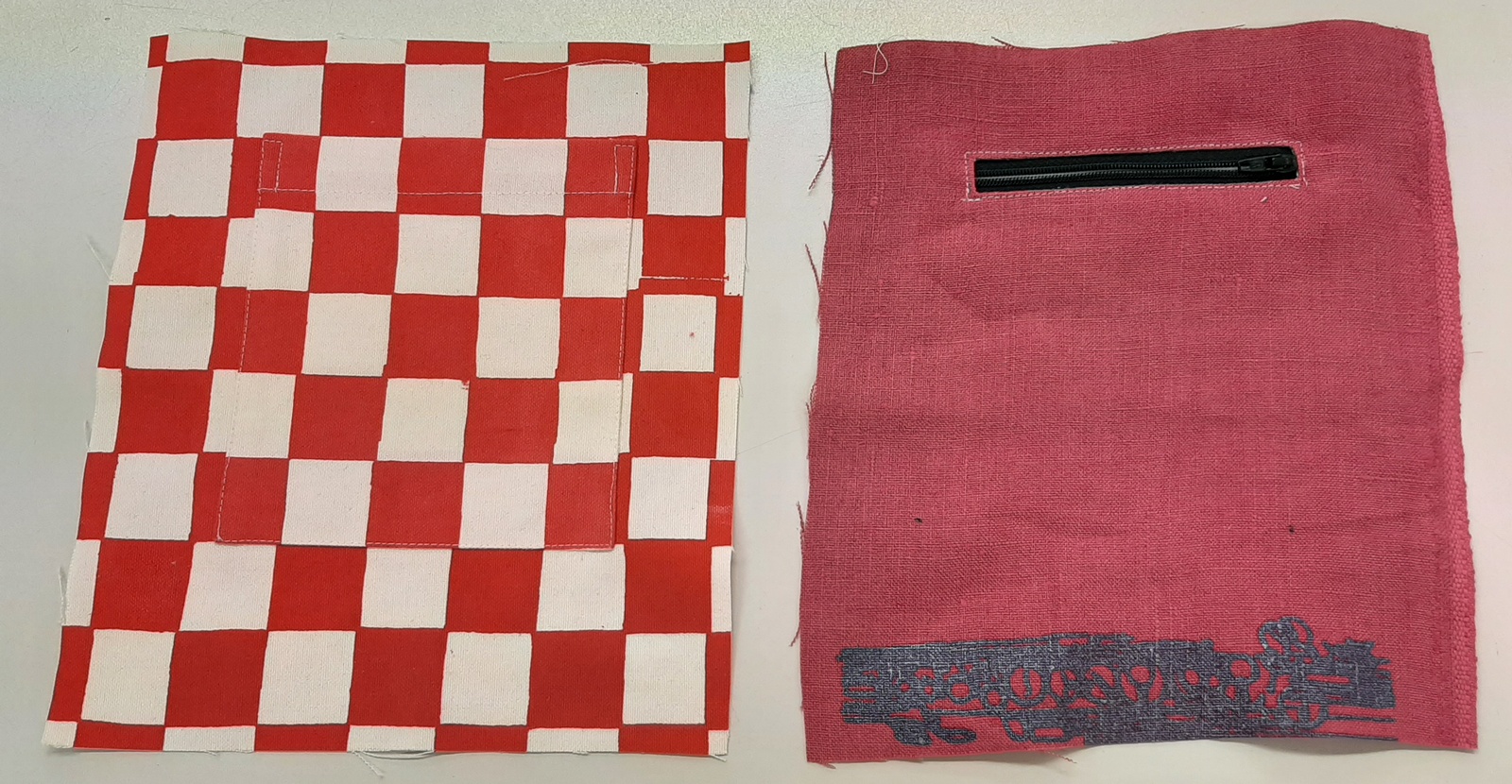
I finally remembered to take pictures of some of the exercises done last week. First one is pockets. And yes, there is a pocket on top of that checkered piece. It's not perfectly aligned, but well enough to make it hard to see the pocket right away. The other one was really an exercise in sewing a zipper. I needed one for the inside pocket in the bag I was planning, so the teacher decided to give us these exercises.


Then we learned how to sew corners as shown in the next picture. It's a good way to sew corners of small table cloths. It took a while to figure out how it is done, but it's not hard once you understand it.


The next exercise was sewing tote bags. I made two. In these, you needed to use at least three different fabrics and sew a pocket on the outside. The green one is the first one I made, and it's bigger, because I made a calculation error and the middle stripe is too high. The other one is really a mixed bag, because I first took the piece with blue stripes and then I had to find fabrics of the same thickness. I kind of like the result, though.


Here's a picture of both bags from the other side.


I have also finished the shoulder bag I mentioned earlier, but that deserves a blog post of its own, so I'll tell about that later.

Saturday, January 23, 2021

Stuff done in the past couple of weeks

It's been a busy week, but I'm really enjoying learning about types of seams and how to make patterns correctly. This post is a sort of recap on all the projects done so far (after the pot holders).

First, some things from the previous week, starting with a set of two simple pouches. Basically an exercise in sewing zippers.


After that, we made a set of makeup pouches, and these were much more complicated. Sewing those rounded corners wasn't easy. The two photos below show the sides of the large pouch (26 x 18 cm).


Here is an inside view. We could pick the fabrics ourselves, and I liked having a bit of pink in the lining as well.


The smaller pouch is 14 x 12 cm. Same pattern, just smaller, and the same fabrics as for the larger one. This particular fabric works better in the larger size as the patterns are so big, but it's okay also in this size.


After I had made this set, the teacher asked me to make another set using the same fabric for the outside. That's what I was doing at the beginning of this week. That set will go on sale at the shop at our school later.

The last finished project so far is two sets of bed linen for babies. These are for a charity that collects items for maternity packs to be delivered to Romania. Each set consists of a duvet cover, pillow case and bed sheet.

The first set is made of a full-size duvet cover made by Benetton. The basic design for this small duvet cover calls for a single color reverse side, but as the original had patterns on both sides, so does the smaller version, which can be used with either side on top.


The duvet cover in the second set is made of several stripes to utilize smaller pieces of fabrics. The reverse side has white and light blue stripes, so this one can also be used with either side on top.


After these, we've started making patterns. The next project is making some kind of a bag totally from scratch. Meaning we start by figuring out the structure and making patterns for the bag. I'm taking my Levi's shoulder bag as the starting point and making some changes to it, such as changing the size a bit and probably leaving out the ability to adjust the shoulder strap. This practice piece is going to be for myself, and I haven't adjusted the shoulder strap in that bag in years, so it's the right length as it is.

Wednesday, December 16, 2020

Recycling the leather

I've been thinking about the leather I got when I removed the stool cover during the smaller upholstery project. There's quite a bit of it, and I want to find a practical way of using it. One of the ideas I had was to make a bag, but I already have one made of leather. My aunt made it and gave it to my mother and I got it when the house was being emptied for sale. It's probably made from furniture industry's leftover pieces and I'm its third owner so far, so it's a well recycled item already.


On the right in the picture are the pieces from the stool. The rectangular pieces (a few dozen) are from the sides and the rest from the top. The top pieces are thinner and more worn than the side pieces, so they're also softer. I like the worn look of the top pieces, but the area they cover isn't large, so they can't be used for anything big. Another restriction is that I haven't sewn leather with a sewing machine before, so I don't want the first project to be anything too complicated. I guess I'll just leave those pieces alone for now and try to figure out something useful.
I think these were originally pieces left over from making bigger furniture, because there was no need to have so many small side panels in the stool otherwise, considering the amount of work the sewing must have required. Then they served their purpose for over 20 years before ending up this way, waiting for their next purpose.

Sunday, November 29, 2020

Leftovers from the upholstery project

When I bought the fabric for upholstering the armchair, I had to get plenty of extra, because I needed to be sure I'd be able to align the patterns to my liking. So, after the armchair was ready, I was left with quite a bit of extra fabric and needed to figure out something to do with it. Shopping bags are always useful, so I used the fabric to make one.


This is an extra bag to be carried inside the regular bag in case I buy so much stuff that one bag isn't enough, so I also made a little pouch to keep the bag in, so it'll take as little space as possible.


In case you're wondering, I haven't been using plastic shopping bags regularly for the past 20 years or so. I always take my own bags with me when I go grocery shopping and only get a plastic bag occasionally, if I end up shopping unexpectedly and haven't had the chance to prepare for it.

It wasn't an environmental thing to start with, just about convenience, because it was so annoying to have those plastic bags accumulate in the cupboard. I used to use them as trash bin liners, but it's cheaper to buy trash bags in a roll as they are made of thinner plastic.

Nowadays I also consider the environmental effect. I've seen calculations on the total cost of using plastic bags versus a bag made of more lasting materials. I don't think those apply, when you use leftover materials for making a shopping bag yourself.

Saturday, June 1, 2013

More card weaving

These are bands I have made after having a lot more practice in card weaving. I found organic cotton yarn at a good price, so I ended up getting quite a lot of it and experimenting with different patterns.


The frame I used for these was just two chair legs joined together.


The chair had four legs, so I got two frames and could work with two bands in parallel.


Here's a closeup in which you can see the cards I'm using. They are made of ordinary playing cards as described in this earlier post.


Most of these bands ended up becoming a handbag. The two side pockets are for a mobile phone and digital camera.


The pockets close with really big snaps.


Inside has a cotton lining and the bag closes with similar snaps as the pockets. There is a small side pocket inside the bag for wallet.


There were some leftover bands and they later became a protective pouch for my Kindle. I will write a separate post later about how I made that.